
Malaysia Haze 2026: Why Indonesia’s Wildfires Affect Malaysia & How to Protect Your Health


If the skies around Petaling Jaya and the Klang Valley have looked unusually grey, visibility seems reduced, or you have noticed a smoky smell in the air, you are not imagining it.
Malaysia is once again experiencing a period of hazy air conditions, with several areas recording unhealthy Air Pollutant Index (API) levels in early October 2026.
On 7 October 2026, 35 locations across Malaysia recorded unhealthy API readings, while Petaling Jaya reached an API of 176, which falls within the Unhealthy category.
But why does haze happen in Malaysia? How can forest and peatland fires hundreds of kilometres away in Indonesia affect the air that we breathe in Petaling Jaya?
And perhaps most importantly — when can we expect clearer skies again?
Here is what you need to know.
What Is Haze?
Haze occurs when there is a high concentration of tiny particles suspended in the atmosphere.
During significant haze episodes, one of the main health concerns is exposure to fine particulate matter, including particles small enough to travel deep into the respiratory tract.
These particles can irritate the eyes, nose, throat and lungs. People with asthma, chronic lung disease, heart disease and other underlying medical conditions may be more sensitive to changes in air quality.
Malaysia uses the Air Pollutant Index (API) to communicate air quality to the public.
The general API categories are:
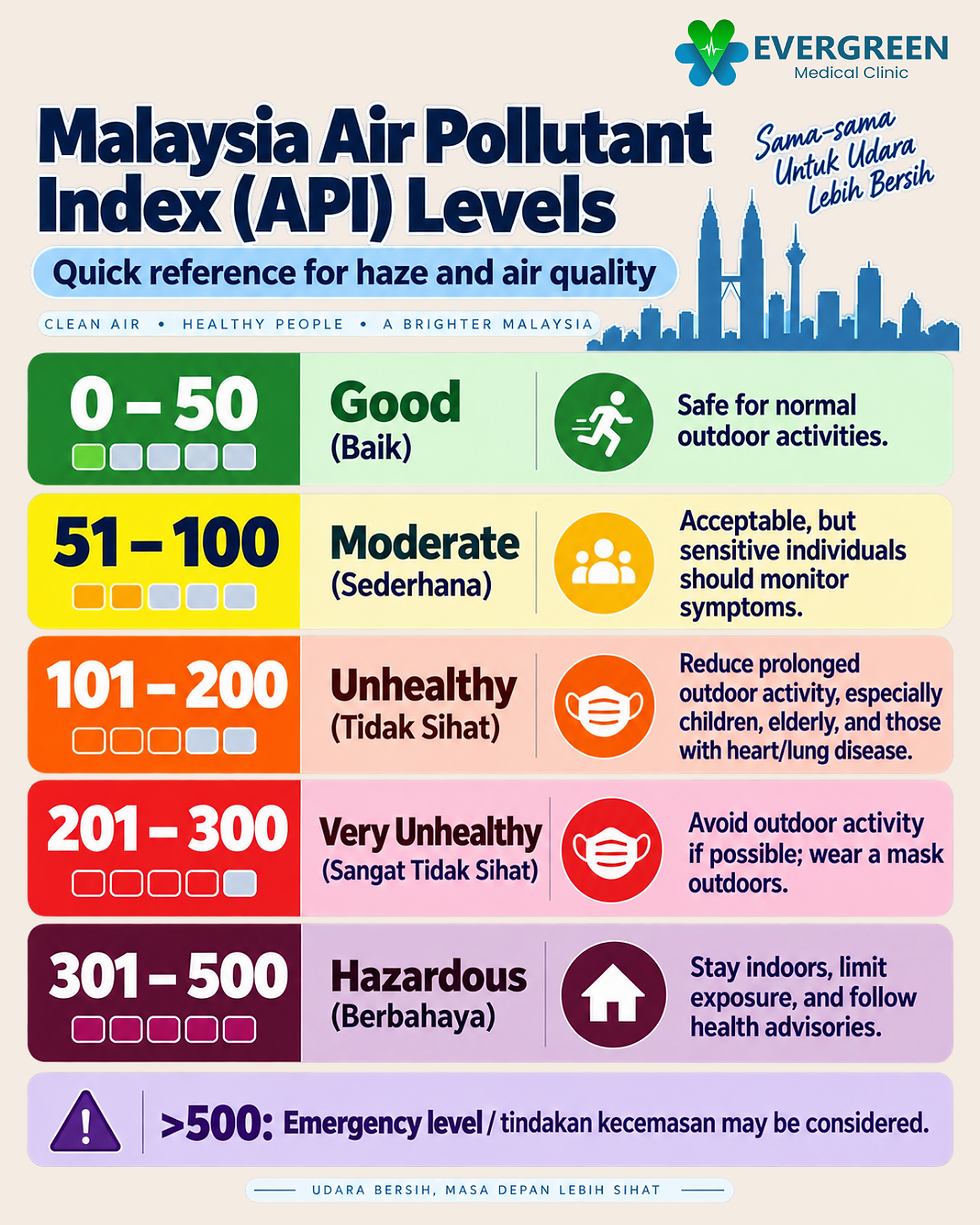
The higher the API reading, the greater the potential health concern, particularly for sensitive individuals.
Why Is Malaysia Affected by Wildfires in Indonesia?
To understand Malaysia's haze problem, it helps to look at our geography.
Sumatra lies immediately west of Peninsular Malaysia, separated from our west coast by the Strait of Malacca.
Further east, Kalimantan occupies much of the island of Borneo, alongside Sabah and Sarawak.
When forest or peatland fires occur in these areas, large amounts of smoke and fine particles can be released into the atmosphere.
If wind direction and weather conditions are favourable, some of this smoke can travel considerable distances across national borders.
This is known as transboundary haze.
How does the smoke reach Malaysia?
Forest and peat fires → smoke enters the atmosphere → prevailing winds transport the smoke → particles cross the region → Malaysian air quality deteriorates.
Because Sumatra is located relatively close to the west coast of Peninsular Malaysia, smoke generated there can sometimes be transported across the Strait of Malacca towards areas such as Selangor, Kuala Lumpur, Negeri Sembilan and Melaka.
This does not mean that every episode of poor air quality in Malaysia is entirely caused by Indonesia.
Local emissions, traffic pollution, industrial activity, weather conditions, wind speed and atmospheric stability can all influence our air quality.
However, transboundary smoke from regional forest and peatland fires has historically been an important contributor during significant Malaysian haze episodes.

Suggested image caption:How smoke from forest and peatland fires in Sumatra can be transported across the Strait of Malacca towards Peninsular Malaysia.
SEO image alt text:Indonesia wildfire smoke travelling from Sumatra across the Strait of Malacca causing haze in Malaysia.
Why Is the Haze Happening Now?
Weather conditions are an important part of the current situation.
Indonesia's meteorological agency, BMKG, reported continued dry conditions across significant parts of Indonesia in early October 2026.
On 4 October 2026, monitoring detected:
• 261 hotspots in Sumatra • 212 hotspots in Kalimantan • 229 hotspots across Papua and Maluku
Satellite imagery also detected smoke over several areas of Sumatra and Kalimantan. Prolonged dry weather allows vegetation and peatland to become increasingly vulnerable to fire. Once fires begin, low rainfall can allow both the fires and the resulting smoke to persist for longer periods.
When Will the Haze Clear?
There is some encouraging news, although haze forecasts can change quickly.
Based on weather forecasts published in early October 2026, haze remained possible around the Klang Valley through approximately 8–10 October, with thunderstorms and improving atmospheric conditions expected afterwards.
This means that conditions may begin improving from around 10 October onwards if rainfall increases and wind patterns become more favourable.
However, this does not mean the haze will suddenly disappear on one particular day.
If regional fires continue and wind patterns again become unfavourable, haze conditions can return.
For this reason, residents should continue checking Malaysia's official Air Pollutant Index (API) rather than relying purely on whether the sky looks clear.
How Can Haze Affect Your Health?
Not everybody responds to haze in the same way. Some people may experience little more than throat irritation or hazy visibility. Others may develop symptoms relatively quickly.
Common complaints during periods of poor air quality can include:
Dry or irritated throat
Coughing
Runny or blocked nose
Eye irritation
Headache
Chest discomfort
Wheezing
Shortness of breath
Worsening asthma or respiratory symptoms
People with existing respiratory or cardiovascular conditions may be particularly sensitive.
Extra precautions should also be considered for:
Young children, Older adults, Pregnant women, People with asthma, People with chronic lung conditions, People with underlying heart disease
5 Ways to Protect Yourself During the Malaysia Haze
1. Wear an Appropriate Face Mask When Going Outside
When air quality is unhealthy and you need to spend time outdoors, consider using a properly fitted KN95, N95 or equivalent high-filtration respirator.
Standard surgical masks do not provide the same level of filtration against very fine haze particles.
The effectiveness of a respirator also depends on obtaining a good seal around the face.
People with significant heart or lung conditions who experience difficulty breathing while wearing a respirator should seek medical advice.

2. Use a HEPA Air Purifier Indoors
When outdoor air quality is poor, reducing the amount of polluted outdoor air entering your home can help reduce exposure.
A properly sized HEPA air purifier can help remove fine airborne particles from indoor air.
Keep windows and doors closed as much as reasonably possible when outdoor air quality is particularly poor.
Run the purifier in rooms where you spend the most time, especially bedrooms and living areas.

3. Stay Adequately Hydrated
Haze exposure can leave the throat and upper respiratory tract feeling dry or irritated.
Continue drinking adequate water throughout the day.
For many adults, around 1.5 litres or more of fluids per day may be a reasonable general target.
However, individual fluid requirements vary depending on body size, physical activity, weather, pregnancy and medical conditions.
Patients who have been advised to restrict fluids because of heart, kidney or other medical conditions should follow their doctor's recommendations instead.

4. Reduce Strenuous Outdoor Activities
When the API reaches unhealthy levels, consider reducing strenuous outdoor exercise.
This may not be the best time for a long outdoor run, football match, cycling session or intense outdoor workout.
During exercise, your breathing becomes faster and deeper.
This can increase the amount of polluted air that enters your respiratory system.
Consider temporarily moving your workout indoors when air quality is poor.

5. What Should You Do If You Become Unwell During the Haze?
Mild irritation may settle after reducing exposure to poor air quality.
However, you should consider seeing a doctor if your symptoms are persistent, worsening or interfering with normal activities.
Seek medical assessment if you develop:
• Persistent or worsening cough• Wheezing• Shortness of breath• Chest tightness• Significant sore throat• Persistent flu-like symptoms• Worsening asthma• Difficulty carrying out normal activities because of breathing symptoms
Seek urgent medical attention if you experience severe shortness of breath, significant chest pain, bluish lips, confusion or rapidly worsening symptoms.
It is also important not to assume that every cough, sore throat or fever occurring during haze season is caused by haze.
Respiratory infections such as influenza and other viral infections can occur at the same time.

6. Stay Indoors When Air Quality Is Poor
If you do not need to be outside, reducing unnecessary outdoor exposure is one of the simplest precautions you can take.
This is particularly important for people who notice that haze triggers coughing, wheezing or worsening asthma symptoms.
Monitor the API throughout the day because air quality can change depending on weather and wind conditions.

Feeling Unwell During the Haze? We Can Help
If you develop persistent cough, sore throat, wheezing, breathing discomfort or flu-like symptoms during the current haze period, Evergreen Medical Clinic in SS19, Petaling Jaya is available for medical assessment.
Depending on your symptoms and medical examination, management may include:
• Doctor consultation and respiratory assessment• Lung examination• Oxygen saturation assessment• Nebulizer treatment when clinically indicated• Inhaler assessment and treatment where appropriate• Asthma management• Treatment for cough, sore throat and flu-like illnesses• General health check-ups• Vaccination advice and preventive healthcare
Nebulizers and inhalers are not routinely required simply because someone has been exposed to haze.
They may be recommended after medical assessment when clinically appropriate, particularly for patients experiencing wheezing, bronchospasm or worsening asthma.
Similarly, vaccines do not treat haze exposure itself.
However, keeping recommended vaccinations up to date — including influenza vaccination where suitable — can form part of an overall preventive healthcare plan.
Monitor the Haze Even When the Sky Looks Better
Haze can fluctuate significantly from one day to another and even within the same day.
A thunderstorm may temporarily improve air quality, while a later change in wind direction may bring polluted air back towards the region.
Instead of judging air quality purely by how the sky looks, check the official Air Pollutant Index (API) before planning prolonged outdoor activities.
For residents around Petaling Jaya, Subang Jaya, SS2, Kelana Jaya, Ara Damansara, Shah Alam and the wider Klang Valley, additional precautions are sensible whenever API readings move into the unhealthy range.
Based on forecasts available in early October 2026, conditions may gradually improve from approximately 10 October onwards, although regional fire activity means the situation can still change.
Need a Medical Check-Up During the Haze?
If you have developed persistent cough, wheezing, breathing discomfort, sore throat or flu-like symptoms, our medical team can assess your condition and determine whether treatment is required.
Evergreen Medical ClinicSS19, Petaling Jaya - General Practice, Respiratory Assessment, Nebulization, Inhaler Care, Vaccinations, Health Screening
Walk in or contact us to arrange an appointment.
Book Online Today: https://booky.my/evergreenmedicalclinic
Get in Touch With Us
Contact: +6018-9698786
Your health. Our community. A brighter tomorrow.
References
Department of Environment Malaysia / Air Pollutant Index Management System (APIMS)
Malaysian Meteorological Department (METMalaysia)
Ministry of Health Malaysia
Badan Meteorologi, Klimatologi, dan Geofisika Indonesia (BMKG)
Badan Nasional Penanggulangan Bencana Indonesia (BNPB)
ASEAN Specialised Meteorological Centre
Information updated: 8 October 2026
Medical Disclaimer: This article is intended for general health education and does not replace an individual medical consultation. Air quality and weather forecasts can change. Patients experiencing severe or rapidly worsening symptoms should seek prompt medical attention.



Comments